

Changing your dog’s food sounds simple — empty one bag, open another. But a sudden swap is one of the most common reasons dogs end up with diarrhea, gas, and an upset stomach. Your dog’s digestive system is home to a community of gut bacteria that is used to breaking down a particular recipe. Change that recipe overnight and those bacteria cannot keep up, which is why the mess usually starts.
The good news is that a slow, planned transition almost always prevents problems. This guide walks you through exactly how to switch dog food without causing diarrhea, step by step, and what to do if your dog is sensitive.
Why a Gradual Switch Matters
Dogs digest food with the help of enzymes and gut microbes tuned to their current diet. A new food may have a different protein source, fat level, or fiber content. Introducing it slowly gives the gut time to adjust its enzyme production and bacterial balance. Most healthy dogs complete a switch in about a week. Puppies, senior dogs, and dogs with sensitive stomachs often do better with ten to fourteen days.
Common Reasons for Switching Dog Food
Understanding why you are switching helps you choose the right pace and the right moment.
- Life stage changes. A puppy moving to adult food, or an adult dog moving to a senior recipe, is the most common reason. These switches are planned, so you can afford the full gradual schedule.
- Health reasons. Your vet may suggest a change because of weight gain, itchy skin, suspected food sensitivities, or a diagnosed condition. In these cases, ask your vet whether the new food should be introduced slowly or whether a faster change is acceptable.
- Your dog has gone off the old food. Boredom is less common than owners think — a sudden loss of interest can also signal a stale bag, dental pain, or feeling unwell, so check those first.
- Better-quality food. Many owners upgrade to a recipe with better ingredients. This is a great reason to switch, but a richer food often has a different fat level, which is exactly why the gut needs time to adapt.
- Availability or budget changes. If the old food is discontinued, buy the new one as early as possible so you still have old food left to mix with — running out completely is the one situation where a cold-turkey switch becomes unavoidable.
Whatever your reason, the method in this guide stays the same. The only thing that changes is the timeline: the bigger the difference between the two foods, the slower you should go.
Before You Start
A little preparation makes the whole process smoother:
- Buy the new food early. You need both foods on hand at the same time, so do not wait until the old bag is empty.
- Check the feeding amounts. Different foods have different calorie densities. Read the new food’s feeding guide and work out your dog’s target daily amount before you begin.
- Weigh or measure portions. Use a kitchen scale or a measuring cup so your ratios are accurate, not guesswork.
- Pick a calm week. Avoid switching during travel, boarding, house moves, or right after vaccinations, when the stomach is already under stress.
- Note your dog’s current stool quality. Knowing what “normal” looks like helps you judge how the transition is going.
The 7-Day Transition Schedule
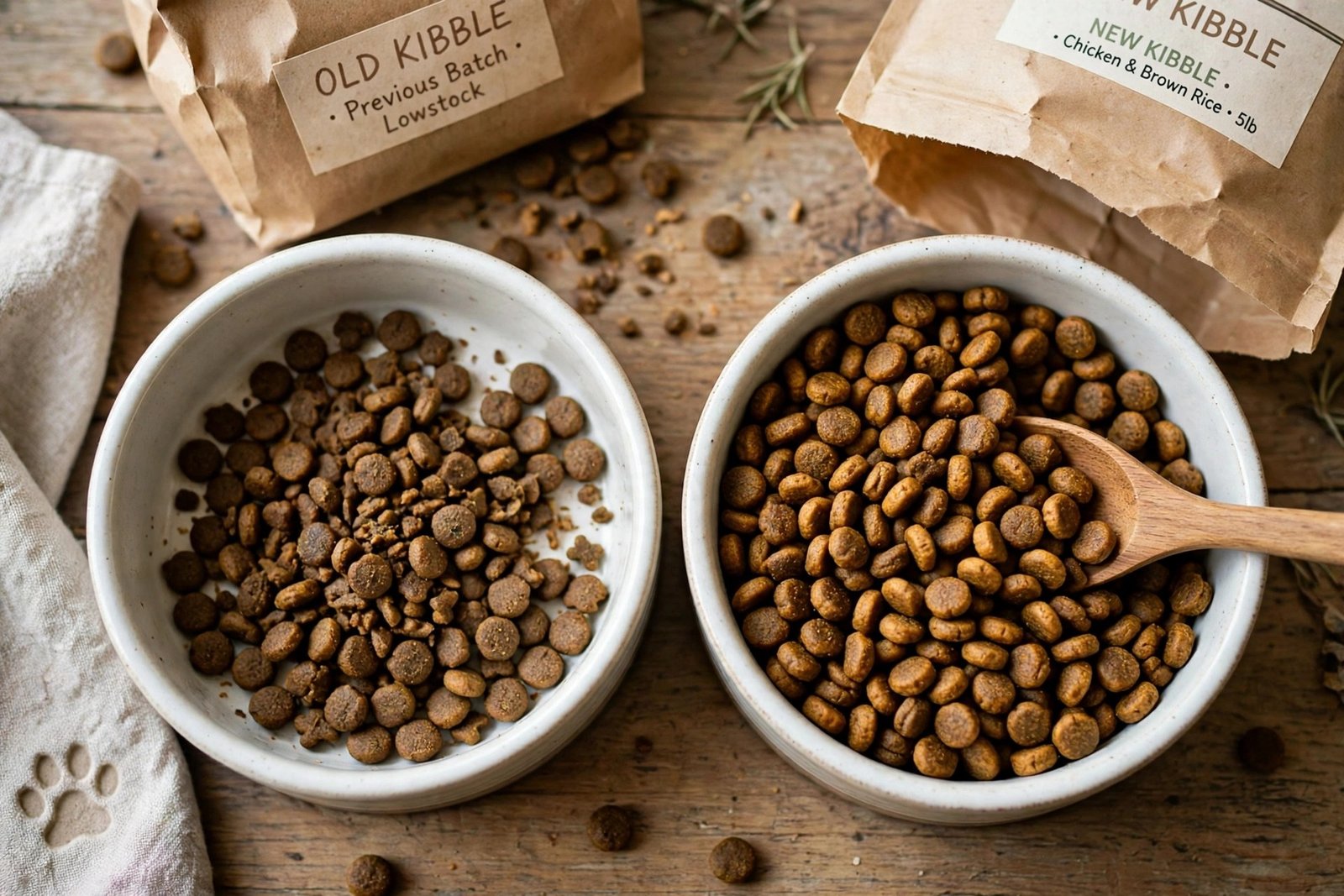
This is the classic schedule vets recommend for most healthy adult dogs. Percentages refer to the total amount of food in the bowl each day.
Days 1–2: 75% old food, 25% new food
Mix three parts old food with one part new food. Most dogs barely notice the change at this stage. Watch the stool — it should stay firm.
Days 3–4: 50% old food, 50% new food
Now the bowl is half and half. This is often when mild gas appears, which is normal. As long as stools stay reasonably formed, keep going.
Days 5–6: 25% old food, 75% new food
The new food now dominates. If stools are still good, you are nearly done.
Day 7 and beyond: 100% new food
Serve the new food on its own. Continue watching stools for another two or three days to be sure the change has settled.
Slower version for sensitive dogs: stretch each step to three or four days instead of two, making the whole transition ten to fourteen days. There is no prize for finishing fast — a comfortable dog is the goal.
Adjusting Portions During the Switch
A detail many owners miss: the old and new foods rarely contain the same number of calories per cup. If you simply swap cup for cup, your dog may quietly gain or lose weight during the transition. Here is how to handle it properly:
- Find the calorie content of both foods. It is printed on the bag, usually as kcal per cup or kcal per kilogram.
- Work out the target amount of the new food. Use the feeding guide on the new bag as a starting point, based on your dog’s weight and whether they need to gain, lose, or maintain.
- Mix by proportion of the meal, not by volume alone. For example, at the 50/50 stage, serve half of the old food’s daily portion and half of the new food’s daily portion. That keeps total calories roughly steady even if the foods differ in density.
- Weigh your dog before and two weeks after the switch. A kitchen scale for the food and a quick weigh-in (at home or at the vet) tells you whether the new portion is right.
Example portion plan for a 20 kg (44 lb) adult dog
- Old food daily portion: 300 g. New food daily portion: 280 g (slightly more calorie-dense).
- Days 1–2: 225 g old + 70 g new.
- Days 3–4: 150 g old + 140 g new.
- Days 5–6: 75 g old + 210 g new.
- Day 7 onwards: 280 g new food only.
Adjust the numbers to your own dog using the guides on each bag — the principle matters more than the exact figures.
Special Cases: Puppies, Seniors and Sensitive Stomachs
Puppies. Young dogs have immature digestive systems and dehydrate quickly if diarrhea starts. Use a 10–14 day schedule, and never begin a switch in the first week after bringing a puppy home — let them settle on the breeder’s food first, then transition.
Senior dogs. Older dogs often have slower digestion and may be on medication. A 10–14 day transition is kinder, and it is worth checking with your vet that the new senior recipe suits any existing conditions such as kidney or joint problems.
Dogs with sensitive stomachs. If your dog has a history of loose stools, stretch each step to three or four days and consider a bland bridge: a few days of plain cooked chicken and rice (under your vet’s guidance) between foods can help very delicate dogs, though it is not needed for most.
Switching between formats. Moving from dry kibble to wet food, or the other way round, is a bigger change than swapping kibble brands, because moisture and fat content differ a lot. Use the slower 10–14 day schedule and mix thoroughly so your dog cannot pick out only the new, tastier pieces.
Signs the Switch Is Going Too Fast
Slow down or pause at the current ratio if you notice:
- Soft, mushy stools or mild diarrhea
- Extra gas or a gurgling stomach
- Reduced appetite or turning away from the bowl
- Occasional vomiting
If mild symptoms appear, go back to the previous ratio that agreed with your dog and stay there for two or three extra days before moving forward again. A spoonful of plain canned pumpkin (100% pumpkin, not pie filling) mixed into meals can help firm up stools during the transition — about a teaspoon for small dogs and a tablespoon for large dogs.
See your vet promptly if diarrhea lasts more than 48 hours, if there is blood in the stool, if your dog vomits repeatedly, refuses all food, seems lethargic, or if the dog is a young puppy — puppies dehydrate quickly. Dogs with medical conditions such as pancreatitis, kidney disease, or inflammatory bowel disease should have any diet change planned with their vet first.
Reading Your Dog’s Stool: A Simple Score Guide
During the transition, your dog’s stool is your best progress report. Vets often describe stool on a simple scale — here is a plain-language version:
- Hard, dry pellets: too firm. Your dog may need more water, or the new food’s fiber level is not ideal. Not an emergency, but worth watching.
- Firm, log-shaped, easy to pick up: perfect. This is what you are aiming for throughout the switch.
- Soft log that holds its shape but is moist: acceptable during a transition, especially around the 50/50 stage. Continue, but do not speed up.
- Soft piles that lose their shape: the switch is going a bit fast. Hold at the current ratio for two or three days.
- Watery with no shape: stop and step back to the previous ratio. If it continues beyond 48 hours or contains blood or mucus, contact your vet.
Checking once or twice a day takes seconds and removes all the guesswork about whether you can move to the next step.
Common Mistakes That Cause Transition Trouble
- Rushing because the old bag ran out. Always start the transition while you still have at least a week’s worth of old food.
- Changing food and treats at the same time. One change at a time means you can identify the culprit if stools soften.
- Letting the dog pick out the new food. Some dogs eat the tasty new pieces and leave the old. Mix thoroughly, and for kibble, a spoonful of warm water mixed through makes selective eating harder.
- Overfeeding “to make up for it.” Owners often add a little extra because the dog seems hungry. Stick to measured portions — extra food alone can cause loose stools.
- Judging the new food too early. Give the new diet at least two to three weeks after the transition finishes before deciding it does not suit your dog, unless symptoms are clearly bad. Coat and energy changes take even longer to show.
Extra Tips for a Smooth Switch
- Keep everything else the same. Do not introduce new treats, chews, or table scraps during the transition week, or you will not know what caused any upset.
- Feed at the same times each day. A predictable routine helps digestion settle.
- Serve fresh water always. Hydration supports healthy digestion, especially if stools soften.
- Store food properly. Keep kibble in its original bag inside an airtight container, and refrigerate opened wet food.
- Do not mix foods long-term. The transition mix is temporary. Once switched, feed the new food as directed so your dog gets the balanced nutrition it was formulated to provide.
What If Your Dog Refuses the New Food?
Some dogs are suspicious of change. Try warming wet food slightly to release its aroma, or add a splash of warm water to kibble to soften it and bring out the smell. Hand-feeding a few pieces as “treats” can convince a picky dog the new food is something special. Avoid the trap of constantly swapping brands — repeated changes make picky habits worse and upset the stomach further. If a healthy adult dog skips a meal or two but is drinking and acting normally, hunger usually wins. If refusal continues beyond two days, or your dog loses weight, talk to your vet.
Frequently Asked Questions
How long should it take to switch my dog’s food?
Seven days works for most healthy dogs. Puppies, seniors, and dogs with sensitive stomachs do better with ten to fourteen days.
Can I switch dog food cold turkey?
It is not recommended. A sudden change is the most common cause of transition diarrhea. A few dogs with iron stomachs cope, but the gradual method is safer for almost every dog.
My dog got diarrhea during the switch. What should I do?
Go back to the last ratio that produced firm stools, hold there for a few extra days, then proceed more slowly. If diarrhea lasts over 48 hours, contains blood, or your dog seems unwell, contact your vet.
Should I add probiotics during a food switch?
Many owners find a dog-specific probiotic helpful during transitions. It is optional, not essential. Ask your vet for a recommendation if your dog has a history of stomach trouble.
Do I need to transition between flavours of the same brand?
If the recipes are very similar (same protein and similar fat/fiber levels), many dogs handle a faster switch. If the protein source changes, use the full gradual schedule.
Can I mix two foods permanently instead of fully switching?
You can, but it is usually better not to. Each complete food is balanced on its own; long-term mixing can unbalance nutrients and makes it hard to spot which food causes a problem if one develops. Short transitions are the intended use of mixing.
What if I run out of the old food before finishing the transition?
Do not panic. Serve the new food in slightly smaller meals for a day or two, add a spoonful of plain pumpkin, and offer plenty of water. Most dogs cope; just watch stools closely for the next few days.
Is it normal for my dog to eat less during the switch?
A slightly reduced appetite for a day or two is common while flavours and smells are unfamiliar. Warming the food or adding warm water usually helps. Refusal lasting more than two days, or any appetite loss in a puppy, deserves a vet call.
Conclusion
Switching dog food without causing diarrhea comes down to one principle: go slowly. Follow the 25%-at-a-time schedule over a week, watch the stools, and be willing to pause if your dog needs more time. With a little patience, your dog gets the benefits of the new food — and you avoid the midnight garden trips nobody enjoys.