

Cooking homemade dog food in big batches saves time and money — but only if you store it safely. The freezer is your best tool: it keeps cooked food fresh for months, lets you portion out exact daily amounts, and means a wholesome meal is always ready. Freezing badly, on the other hand, leads to freezer burn, wasted food, and meals your dog refuses.
This guide covers exactly how to store homemade dog food in the freezer, from cooling and portioning to thawing and serving.
How Long Does Homemade Dog Food Last in the Freezer?
For best quality, use frozen homemade dog food within 2–3 months. It remains safe beyond that if kept continuously at −18°C (0°F) or colder, but texture, flavour, and nutrient quality slowly decline, and most dogs notice the difference. Cooked food keeps only 3–4 days in the fridge, so anything you will not use within that window should be frozen on cooking day.
Why Freezing Works — and What It Does Not Do
Freezing at −18°C (0°F) does not sterilise food; it pauses it. Bacteria and moulds stop multiplying at freezer temperatures, which is why frozen food stays safe for months. But the moment food thaws, those microbes wake up — which is why thawed food has a short 24-hour fridge life and must never be refrozen. Two practical consequences follow:
- Freeze food at its freshest. Freezing cannot improve tired ingredients. If a batch was already two days old when it went in, it comes out two days old.
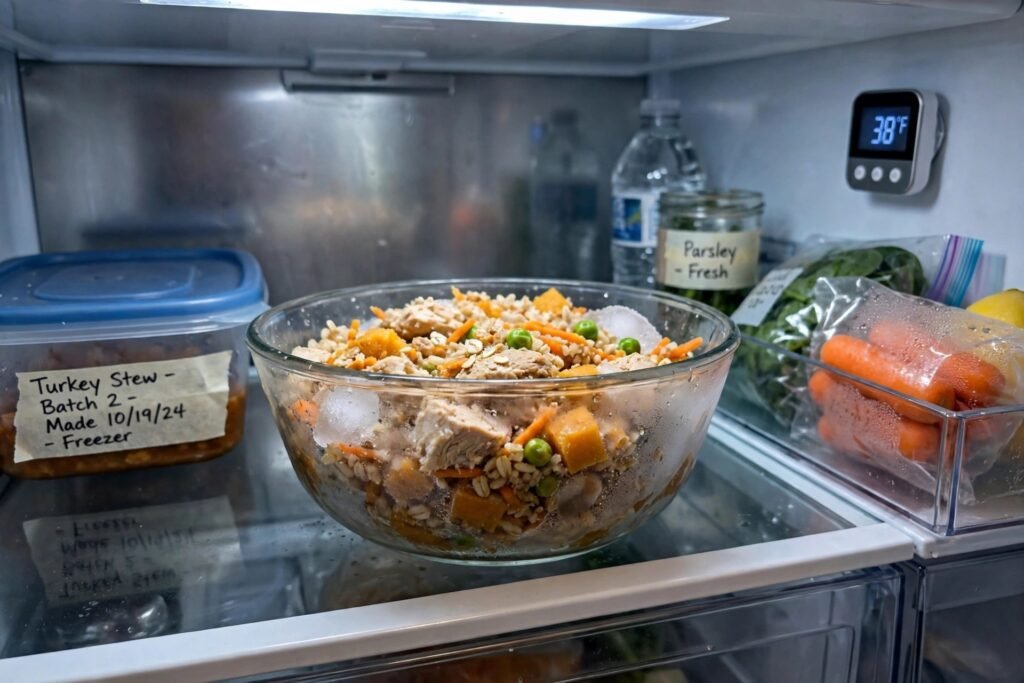
- Speed matters when cooling and freezing. The faster cooked food passes through the “warm zone” (roughly 5–60°C / 40–140°F) where bacteria multiply quickly, the safer the stored meal. Shallow containers, the fridge within 1–2 hours, and a not-overcrowded freezer all shorten that window.
Understanding this one idea — the freezer is a pause button, not a reset button — explains almost every rule in this guide.
Step-by-Step: Freezing Homemade Dog Food
Step 1: Cool the food quickly and safely
Never put a steaming pot straight into the freezer, and never leave cooked food sitting out for hours. Spread the food in a shallow layer in a wide container so it cools faster, and refrigerate it within 1–2 hours of cooking. Aim to freeze it once it is cold, ideally the same day.
Step 2: Portion before you freeze
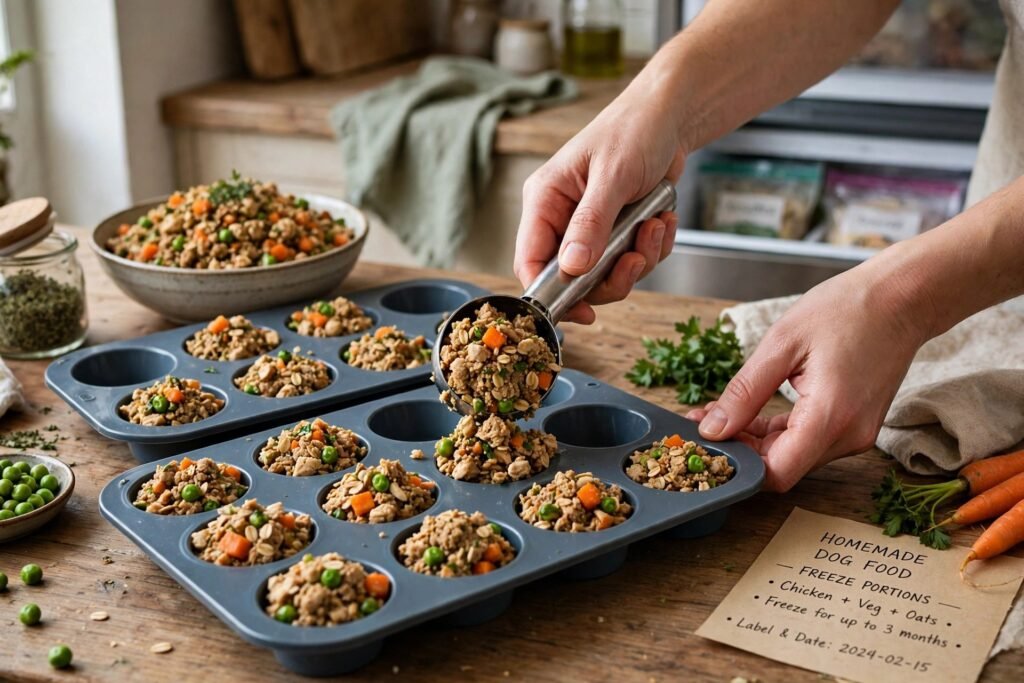
Portioning is the single most useful habit. Work out how much your dog eats per meal or per day, then divide the batch into exactly those amounts. That way you thaw one portion at a time and never waste food or refreeze leftovers. Weigh portions on a kitchen scale (for example, 200 g or 400 g tubs) for accuracy.
Step 3: Choose the right containers
- Freezer-safe tubs with tight lids — reusable, stackable, and easy to label.
- Silicone muffin trays or ice-cube trays — brilliant for small dogs or for topper-sized portions; freeze, pop out the blocks, then store them in a bag.
- Freezer bags — squeeze out the air, lay them flat to freeze, and stack them like files to save space.
- Glass jars — fine if freezer-safe, but leave generous headspace because food expands as it freezes; never fill to the brim.
Avoid thin containers that crack, and skip reusing single-use plastic tubs that were not designed for freezing.
Step 4: Leave headspace and seal well
Fill containers to about 90% full — food expands roughly 10% as it freezes. Remove as much air as you can from bags, and check every lid is sealed tight. Air is the enemy: it causes freezer burn (dry, grey patches) and off-flavours.
Step 5: Label everything
On each container write: the recipe, the date frozen, and the portion weight. Labels matter more than you think — after two weeks, every frozen block of dog food looks identical, and “mystery meat from March” helps nobody.
Step 6: Freeze flat and cold
Place freshly packed portions in the coldest part of the freezer (usually the back), laid flat where possible so they freeze quickly and thaw evenly. Once solid, stack them neatly. Keep the freezer at −18°C (0°F) or below.
How to Thaw and Serve Frozen Dog Food
- Move one portion to the fridge the night before you need it — allow roughly 12–24 hours for a typical 300–500 g portion to thaw fully.
- Serve at room temperature or gently warmed. A few seconds in the microwave or a warm-water bath for the sealed container takes the chill off. Stir well and check for hot spots before serving — never serve food piping hot.
- Use thawed food within 24 hours, and keep it refrigerated until mealtime.
- Never refreeze thawed food. If your dog leaves some in the bowl, discard it after 1–2 hours at room temperature.
- If you forgot to thaw: run the sealed container under cool water, or defrost gently in the microwave and serve once fully thawed and stirred.
Freezer Storage Times at a Glance
- Cooked meat-and-vegetable meals: best within 2–3 months
- Cooked meat on its own (portioning for later recipes): 2–3 months
- Raw meat portions (if you freeze ingredients): use within 3–4 months and handle with strict hygiene
- Cooked rice or grains alone: up to 3 months, though texture softens
Suggested Portion Sizes by Dog Size
Match your container size to your dog so a single thaw equals a single day (or a single meal). Assuming a typical cooked homemade meal of about 100–120 kcal per 100 g:
- Toy/small dog (3–6 kg / 7–13 lb): 150–250 g per day — freeze in 75–125 g muffin-tray pucks, two per day.
- Medium dog (10–20 kg / 22–44 lb): 400–700 g per day — freeze in 200–350 g tubs, two per day, or one daily tub if you prefer.
- Large dog (25–35 kg / 55–77 lb): 800 g–1.1 kg per day — freeze in 400–550 g tubs, two per day.
Calorie needs vary a lot with age, neutering, and activity, so treat these as starting portions and adjust according to your dog’s waistline over a few weeks. Freezing a few smaller “topper” portions (50–100 g) is also handy for dogs who eat mostly commercial food with a homemade boost.
Keeping the Freezer Organised: First In, First Out
A rotation system takes ten seconds and prevents the sad discovery of ancient, unlabelled blocks:
- New portions go at the back or bottom. Oldest food stays at the front where you will grab it first.
- Group by recipe. A small box or bag per recipe keeps turkey dinners separate from fish ones — essential if you are rotating proteins or testing what suits a sensitive dog.
- Keep a freezer list. A sticky note on the door (“Turkey ×6 portions, frozen 3 May”) beats excavation archaeology every time.
- Audit monthly. Move anything approaching the 2–3 month mark to the front and plan to use it this week.
- Do not overfill. Air needs to circulate for even temperatures. A packed-solid freezer with the door barely closing freezes slowly and unevenly.
Troubleshooting: When Frozen Food Comes Out Wrong
- Dry, pale patches (freezer burn). Caused by air reaching the surface. The food is safe but less tasty; trim the worst patches after thawing. Prevent it with airtight seals, bags pressed flat with air squeezed out, and using food within the recommended window.
- A layer of ice crystals inside the container. Usually means the food went in warm, or the container had too much headspace. Harmless but a sign to cool fully and pack tighter next time.
- Watery puddle after thawing. Normal for vegetable-rich meals — vegetables release water as they thaw. Stir the liquid back in; it carries flavour and water-soluble nutrients, so do not drain it away.
- Mushy rice or pasta. Grains soften in the freezer. If your dog dislikes the texture, slightly undercook grains by a minute before freezing, or add freshly cooked grains at serving time.
- Food smells fine but the dog refuses it. Often the batch was frozen too long or stored next to strong-smelling human food (dog food absorbs freezer odours through poor seals). Serve gently warmed, and shorten storage times for the next batch.
Hygiene Habits That Keep Everyone Safe
Homemade dog food is real food, and it deserves the same kitchen hygiene as your own meals: wash hands before and after handling, use a dedicated chopping board for raw meat, wash containers in hot soapy water (or a dishwasher) between batches, and clean the dog’s bowl after every meal rather than topping it up. Label raw and cooked items unmistakably. If anyone in the household is pregnant, elderly, or has a weakened immune system, be extra strict about raw-meat handling and thawing on a tray on the fridge’s bottom shelf.
Common Mistakes to Avoid
- Freezing a warm pot — raises the freezer temperature and endangers other food.
- Freezing one giant block — you will chip at it for days and waste the rest.
- Skipping labels — leads to old, unidentifiable food being binned or fed past its best.
- Refreezing thawed meals — a real bacterial risk; always portion so you thaw only what you will use.
- Using the fridge door shelf for thawed food — it is the warmest spot; use a lower shelf instead.
Planning a Batch That Fits Your Freezer
Before a big cooking day, do the simple maths: your dog’s daily portion in grams, multiplied by the number of days you want to cover, equals the batch size you need. A 15 kg (33 lb) dog eating roughly 500 g a day needs about 3.5 kg of food for one week — that is roughly seven 500 g tubs, or 3.5 litres of freezer space once packed flat. Knowing this in advance stops the classic problem of a beautiful batch with nowhere to live. If freezer space is tight, freeze in flat bags rather than tubs, plan 7–10 days of food instead of a month, and consider a small countertop freezer as one of the best investments a home-cooking dog owner can make.
Frequently Asked Questions
Can I freeze homemade dog food with rice and vegetables in it?
Yes. Fully cooked mixed meals freeze well. Vegetables like carrots, green beans, and sweet potato hold their texture nicely; leafy greens soften but remain nutritious.
Does freezing homemade dog food destroy nutrients?
Freezing preserves nutrients far better than long fridge storage. Some water-soluble vitamins decline slightly over months, which is another reason to use food within 2–3 months.
How can I tell if frozen dog food has gone bad?
Trust your senses after thawing: a sour or “off” smell, sliminess, or unusual colour means discard it. Heavy freezer burn mainly harms quality — trim badly burned parts, and if in doubt, throw it out.
Can I freeze food in the container my ingredients came in?
Only if it is clearly freezer-safe. Thin yoghurt-style pots and takeaway tubs often crack at low temperatures; transfer the food to proper freezer containers.
My dog is fussy about thawed food. Any tips?
Serve it gently warmed to release the aroma, and make sure it was frozen fresh and used within a month or two — fresher frozen food tastes much better. A spoonful of freshly cooked topper can also win a sceptic over.
What should I do with frozen dog food after a power cut?
If the freezer stayed closed, food usually remains safe for about 24 hours in a full freezer (less if half-full). If portions have fully thawed and reached room temperature, or you are unsure how long they were warm, discard them — it is not worth the risk. When in doubt, throw it out.
Can I freeze raw ingredients and cooked meals in the same freezer?
Yes, but keep them separated and clearly labelled to avoid mix-ups, and give raw meat its own shelf or box. Always thaw raw ingredients in the fridge on a tray to catch drips, and wash hands, boards, and bowls thoroughly after handling raw meat.
Is it okay to microwave dog food straight from frozen at mealtime?
In a pinch, yes — defrost on a low setting, stir thoroughly to remove cold and hot spots, and let it stand a minute before serving. Fridge thawing gives a better texture and is safer, so treat the microwave as the backup plan, not the routine.
Conclusion
Storing homemade dog food in the freezer is simple once you build the habit: cool it quickly, portion it precisely, pack it airtight, and label it clearly. Thaw portions in the fridge overnight, use them within a day, and never refreeze. With a well-organised freezer, home-cooked meals for your dog become as convenient as opening a bag of kibble — and far fresher.