

Feeding a large breed puppy is a serious commitment: a young Labrador, German Shepherd or Golden Retriever can eat more than many adult dogs while growing for 12 to 18 months. It is natural to look for savings — but with big puppies, the cheapest food is not always the best bargain. Poorly balanced food can mean vet bills later, especially for bones and joints.
The good news is that “affordable” and “good quality” overlap more than you might think. This guide shows you exactly what a large breed puppy needs, how to spot a genuinely good budget food, and where reputable brands offer large-breed puppy recipes at sensible prices.
What Large Breed Puppies Actually Need
Controlled calcium for safe growth
This is non-negotiable. Large breed puppies need controlled calcium (roughly 1.0–1.4% dry matter) and a balanced calcium-to-phosphorus ratio. Too much calcium is linked to skeletal problems in fast-growing big puppies. Always choose a food labelled for large breed puppies or for growth of large-size dogs — this is the one feature you should never trade away for price.
Quality protein, sensible calories
Look for around 22–28% protein with a named meat source first on the label. Calories should be moderate: big puppies should grow steadily and stay lean, not round. Overfeeding — even a great food — is one of the most common and costly mistakes.
DHA and joint-friendly nutrition
DHA from fish oil supports brain development. Some large-breed recipes also include nutrients that support cartilage. These are bonuses, but the calcium control and calorie balance matter most.
How to Spot a Good Budget Food
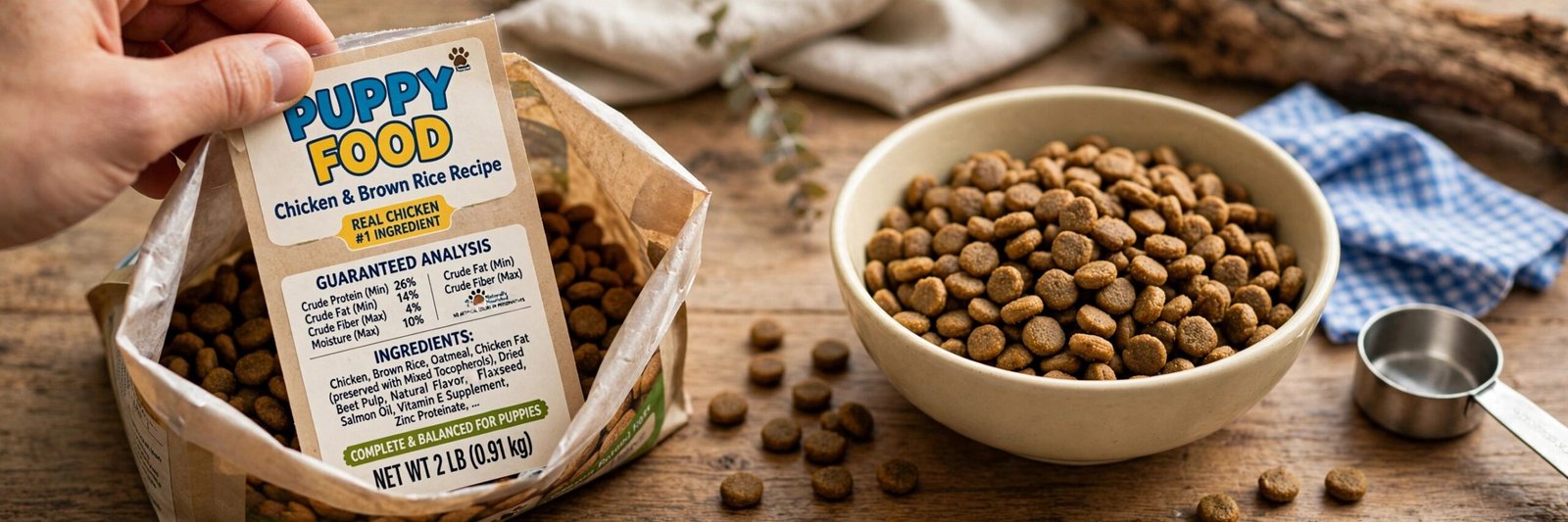
Use this label checklist when comparing prices:
- Life-stage statement: “complete and balanced for growth” including large breed growth
- First ingredient: a named meat or meat meal (chicken, chicken meal, lamb meal)
- No vague fillers: avoid foods led by unnamed “meat derivatives” or mostly corn and by-products
- No artificial colours or flavours
- A feeding guide and calorie count printed on the bag, so you can compare cost per day, not just cost per bag
Compare cost per day, not per bag. A slightly pricier food that is more calorie-dense and digestible may need smaller portions, closing the price gap — and it usually produces smaller, firmer stools too.
A worked example: doing the maths on two bags
Imagine two large-breed puppy foods on the shelf:
- Food A costs 40 (in your currency) for a 12 kg bag, and the feeding guide says your puppy needs 400 g a day. That bag holds 30 days of food: about 1.33 per day.
- Food B costs 48 for a 12 kg bag — it looks like the expensive one. But it is more calorie-dense, so the guide says 320 g a day. That bag holds about 37 days of food: roughly 1.30 per day.
The “expensive” food is actually the same price or cheaper per day, before you even count the smaller stools and less waste. This is why the calorie count and feeding guide on the bag matter more than the headline price. (These figures are an illustration — run the same sum with the real prices and guides in your shop.)
What “Affordable” Should Never Mean
Saving money is smart; some shortcuts are not. However tight the budget, never:
- Feed adult or all-life-stages food that is not approved for large-breed growth — the mineral balance is the whole point.
- Dilute a complete food with lots of cheap extras like plain rice or bread at every meal. A little is harmless; a lot unbalances the diet and short-changes protein and minerals.
- Buy dented, expired or already-open discounted bags. Rancid fats and stale food are false economies and can upset a puppy’s stomach.
- Switch brands every time something is on offer. Constant changing causes digestive upsets and picky habits. Pick a good food your puppy thrives on and stay with it — stability is a saving in itself.
Reputable Affordable Options
Prices vary by country and shop, but these widely available brands are known for solid large-breed puppy recipes at fair prices:
- Purina Pro Plan Large Breed Puppy — a step up from basic lines, with controlled minerals and live probiotics in many recipes
- Pedigree Puppy and Purina Dog Chow Puppy — among the most affordable complete options in many markets; check the large-breed suitability and feeding guide carefully
- Iams ProActive Health Large Breed Puppy — a mid-priced staple with named chicken protein and added DHA in many markets
- Diamond Naturals Large Breed Puppy — often good value, with lamb protein and no corn, wheat or soy in the recipe
- Store-brand large breed puppy foods from major pet retailers — often made to the same nutritional standards; the label checklist above is your quality test
Whichever you choose, buy the largest bag you can store properly — cost per kilo drops noticeably — and keep it sealed in a cool, dry place.
Switching From the Food Your Puppy Came Home On
Most puppies arrive eating whatever the breeder or rescue used, which may be pricey, hard to find, or simply not a large-breed recipe. You do not need to switch on day one — in fact, you should not. Keep the puppy on the familiar food for the first week or so while they settle in; a new home, new people and new food all at once is a recipe for an upset stomach.
When you are ready, transition over about seven days: roughly a quarter new food for two days, half and half for two days, three-quarters new for two days, then all new. If stools soften, slow down a stage. This gradual switch also protects your budget: you use up the food you already have instead of throwing it away, and you can start with a smaller bag of the new food to make sure it suits your puppy before committing to the biggest, cheapest-per-kilo size.
If the food your puppy came on turns out to be a sound large-breed recipe at a fair price, the most economical choice of all may be to simply stay with it — loyalty to one good food beats a clever bargain your puppy’s stomach rejects.
Smart Ways to Save Without Cutting Corners
- Measure every meal. Free-feeding wastes food and fattens puppies. A measuring cup or kitchen scale saves money and joints
- Buy in bulk during offers, but check expiry dates and store food airtight
- Use kibble as training treats from the daily allowance instead of buying lots of extras
- Skip unnecessary toppers. Wet food and extras add cost fast; a splash of warm water makes kibble smell richer for free
- Do not over-supplement. Extra calcium or vitamins on top of a complete food can unbalance it and harm growth — more is not better
Feeding Amounts and Schedule
Follow the bag’s guide for your puppy’s age and expected adult weight, then adjust by body condition:
- 2–4 months: 4 meals a day
- 4–6 months: 3 meals a day
- 6 months onwards: 2 meals a day
- 12–18 months: move to an adult large breed food, transitioning over a week
A rough guide by age (for a puppy expected to reach about 25–35 kg as an adult, eating a typical large-breed puppy kibble at around 350 kcal per cup):
| Age | Meals per day | Total food per day (approx.) |
|---|---|---|
| 2–3 months | 4 | 1¾ – 2¼ cups (175–225 g) |
| 3–4 months | 4 | 2¼ – 3 cups (225–300 g) |
| 4–6 months | 3 | 3 – 3½ cups (300–350 g) |
| 6–9 months | 2–3 | 3½ – 4¼ cups (350–425 g) |
| 9–12 months | 2 | 3¾ – 4½ cups (375–450 g) |
| 12–18 months | 2 | Adjust to body condition as growth slows |
Giant-breed puppies (expected over 40 kg) generally sit at or above the top of these ranges; smaller “large” breeds sit at the bottom. The bag’s guide for expected adult weight plus the rib check always wins over any general table.
Weigh your puppy every two weeks. You should feel ribs easily under a light fat covering. If your puppy looks ribby, add a little; if the waist disappears, cut back slightly and check with your vet at the next visit.
Storage: Where Good Food Goes to Waste
A big bag only saves money if it stays fresh. Fats in kibble oxidise once the bag is opened, and stale food loses both nutrients and appeal:
- Keep kibble in its original bag (the bag is designed as a fat barrier and carries the batch details), folded down and clipped, inside an airtight container.
- Store in a cool, dry place — not a hot garage or next to a cooker.
- Aim to finish an opened bag within about six weeks.
- Scoop from the top rather than tipping the container, and wash the container between bags to remove rancid fat residue.
- If food smells sour, oily or “off”, do not feed it — a cheap bag thrown away once is better than a vet visit.
Common Mistakes Budget-Conscious Owners Make
- Choosing by protein percentage alone. A high-protein bargain food with uncontrolled calcium is a worse buy than a moderate-protein food formulated for large-breed growth.
- Overfeeding to “get value” from a big bag. Extra food does not speed healthy growth; it adds fat and joint strain, and the bag empties faster anyway.
- Mixing two half-used foods together to use them up. Mixing different recipes makes portions and nutrients unpredictable — finish one food, transitioning properly into the next.
- Forgetting the treat budget. Pricey training treats and chews can quietly cost as much as the food itself. Kibble from the daily allowance costs nothing extra.
- Skipping vet checks to save money. Puppy visits catch growth, weight and parasite issues while they are still cheap and simple to fix.
Pros and Cons of Budget Puppy Foods
Pros
- Big savings over a year of heavy puppy feeding
- Reputable budget lines still meet complete-and-balanced standards
- Widely available, so you are never stuck without food
Cons
- Some budget recipes use more grains and fewer named meats — the label check matters
- Digestibility can be lower, meaning larger portions and more waste
- Large-breed-specific budget options are fewer in some countries and may need ordering online
Frequently Asked Questions
Is expensive food always better for a large breed puppy?
No. Price alone does not guarantee balanced calcium or better nutrition. A mid-priced food that meets large-breed growth standards beats a costly food that is not formulated for big puppies.
Can I feed adult food to save money?
No. Adult food may have the wrong calcium levels, fewer calories per cup and no DHA focus for growth. Puppies need puppy food until 12–18 months, depending on breed.
How long does a bag of puppy food last?
It depends on the puppy’s size and the food’s calorie density. A growing large breed puppy may eat 3–5 cups a day, so a 12–15 kg bag often lasts about a month.
Should I add calcium or bone meal to cheap food?
Never add calcium to a complete puppy food. Excess calcium is a known risk for large breed puppies’ bones. If the food is complete for large-breed growth, it already has the right amount.
What if my puppy refuses a budget food?
Transition gradually over 7 days, serve food at room temperature, and remove uneaten food after 20 minutes. If refusal continues with loose stools or weight loss, see your vet.
Are supermarket own-brand puppy foods safe?
Many are formulated to the same complete-and-balanced standards as famous brands. Run them through the label checklist in this guide — large-breed growth statement, named meat first, calorie count shown — and a passing own-brand can be a perfectly good buy.
Can I mix a budget food with a premium food to save money?
You can, but it complicates the maths: the mix’s calcium and calories sit somewhere between the two, and neither feeding guide quite applies. If you mix, keep the ratio constant, make sure BOTH foods are large-breed puppy formulas, and monitor body condition closely.
Conclusion
Affordable large breed puppy food absolutely exists — the secret is reading labels instead of prices. Insist on large-breed growth formulation with controlled calcium, a named meat first, and measured portions that keep your puppy lean. Buy bigger bags, use kibble for training, and skip the extras. Your wallet stays healthy, and so do your puppy’s bones, joints and waistline.