

A Rottweiler puppy grows from a tiny bundle into a powerful 40–50 kg dog in little more than a year, and what you feed during those months shapes their bones, joints and lifelong health. The golden rule for this breed is simple: steady, controlled growth beats fast growth every time. The best food for a Rottweiler puppy is a large-breed puppy formula with balanced calcium, sensible calories and quality protein — not the richest food you can find.
This guide explains exactly what to look for on the label, which reputable brands make suitable large-breed puppy foods, and how to feed for strong, slow, healthy growth.
What Rottweiler Puppies Need Most
Controlled Calcium and Phosphorus
This is the single most important point. Too much calcium in a large-breed puppy’s diet is linked to skeletal problems, including joint and growth-plate issues. Look for a large-breed puppy food with calcium roughly in the range of 1.0–1.5% on a dry-matter basis, and never add calcium supplements, bone meal or extra milk products to a complete puppy food — the balance is already worked out by the manufacturer.
Moderate Calories and Fat
Rottweiler puppies should look lean, not round. Excess weight puts strain on developing joints. A suitable large-breed puppy food typically has around 14–16% fat and moderate calories per cup, designed to slow growth slightly compared with regular puppy food.
Quality Protein for Muscle
Protein supports muscle, immune health and coat. Aim for roughly 26–30% protein from named animal sources (chicken, lamb, fish or beef listed clearly) as the first ingredients.
Joint-Supporting Nutrients
Omega-3 fatty acids (EPA and DHA from fish oil) support developing joints, eyes and brain. DHA is especially valuable in the first months of life. Some owners also look for glucosamine and chondroitin, which are included in many large-breed formulas.
Kibble Size and Digestibility
Rottweiler puppies do best on a larger kibble that encourages chewing rather than gulping, and a highly digestible recipe means smaller, firmer stools — a good sign the food agrees with your puppy.
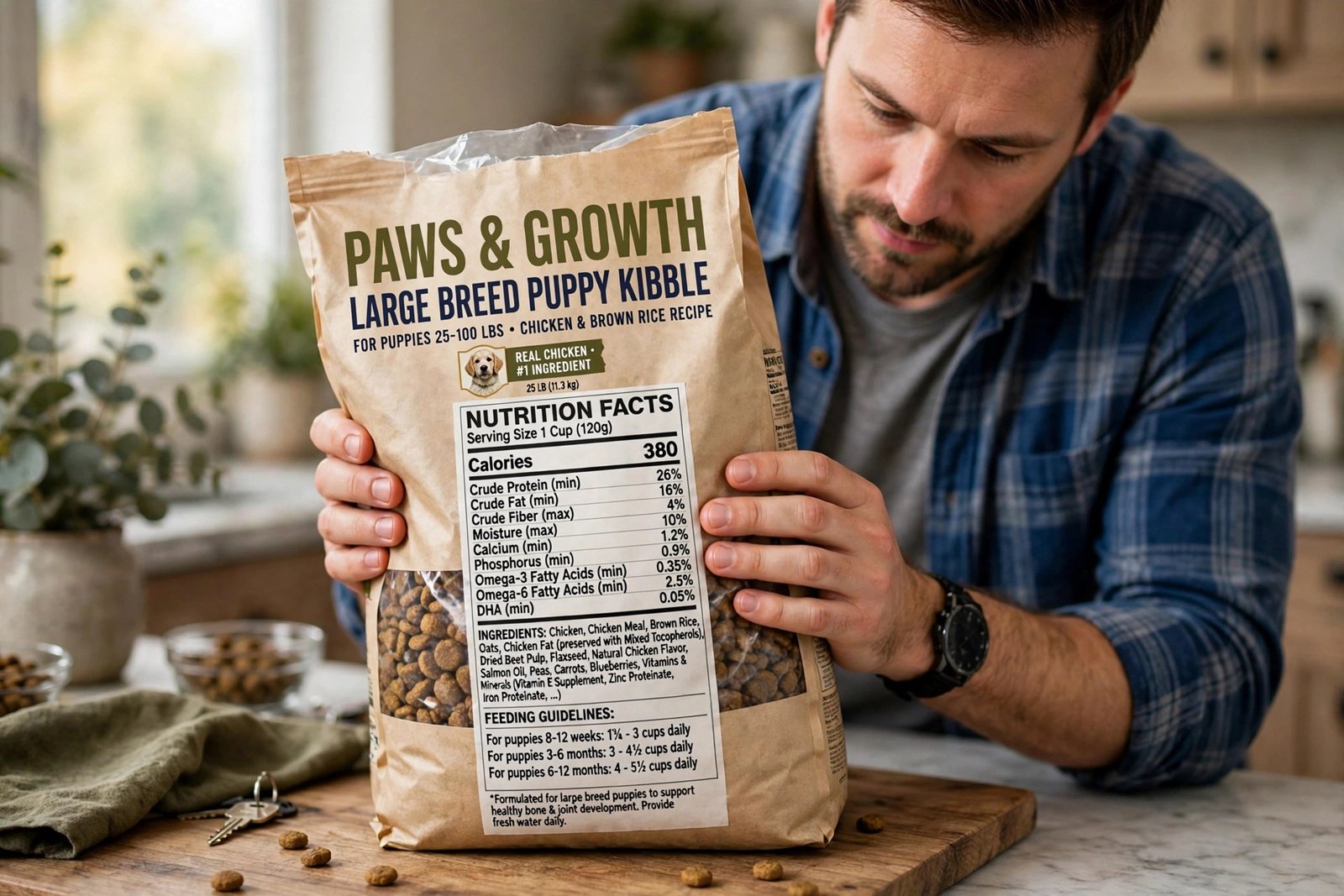
How to Read a Large-Breed Puppy Food Label
Packaging can be confusing, but a few checks separate a genuinely suitable food from ordinary puppy food in a bigger bag.
- Find the life-stage statement. The bag should state the food is complete and balanced for growth, ideally with wording such as “including growth of large size dogs” (AAFCO) or the FEDIAF equivalent in Europe. That phrase means the nutrient levels, including calcium, have been set with big puppies in mind.
- Check the calcium figure. It may be printed in the guaranteed analysis or on the brand’s website. For a large-breed puppy food, calcium around 1.0–1.5% on a dry-matter basis (roughly similar as-fed in dry food) is the commonly advised zone, with phosphorus in proportion and a calcium-to-phosphorus ratio a little above 1:1. Ordinary puppy foods can run noticeably higher — fine for a terrier, not ideal for a Rottweiler.
- Read the first ingredients. A named meat (chicken, lamb) or named meat meal should be first. Vague terms like “meat and animal derivatives” give you no control over what your puppy actually eats.
- Check calorie density. Large-breed puppy foods are deliberately moderate — often around 350–380 kcal per cup. Very rich foods (420+ kcal per cup) make it easy to overfeed a growing giant breed without noticing.
- Look for DHA. Fish oil, salmon oil or algae in the ingredients supplies the DHA that supports brain and eye development in the first months.
- Be wary of “all life stages” foods with high calcium. Some are suitable, but many are formulated closer to regular puppy food. When in doubt, a dedicated large-breed puppy formula is the safer default for this breed.
Feeding Amounts and Schedule for Rottweiler Puppies
Exact amounts depend on the food’s calorie content, so always cross-check with the guide on your bag. As a general pattern for a typical large-breed puppy kibble:
- 8–12 weeks (roughly 5–9 kg): about 2–3 cups (200–300 g) per day, split into 3–4 meals
- 3–4 months (roughly 10–17 kg): about 3–4 cups (300–400 g) per day, split into 3 meals
- 5–6 months (roughly 18–27 kg): about 4–5 cups (400–500 g) per day, split into 2–3 meals
- 7–12 months (roughly 28–40 kg): about 4½–5½ cups (450–550 g) per day, split into 2 meals
- 12–18 months: amounts level off; many dogs move to a large-breed adult food somewhere in this window, on your vet’s advice
Weigh the food with a kitchen scale rather than eyeballing cups, and weigh your puppy every 1–2 weeks. You are aiming for steady, even growth — roughly, a Rottweiler puppy gains steadily week by week without looking round. If you can no longer feel ribs easily, trim portions by about 10%; if ribs and hip bones become prominent and your puppy is not simply going through a lanky phase, discuss it with your vet before adding food, because proportion matters more than volume in this breed.
Keep treats inside the day’s allowance. Training rewards are essential for a young Rottweiler, but use part of the weighed daily kibble ration or tiny, low-calorie treats, and keep extras to about 10% of intake so the calcium balance of the main diet is barely disturbed.
Trusted Large-Breed Puppy Foods to Consider
- Royal Canin Rottweiler Puppy — a breed-specific formula with adapted protein, calcium and kibble shape for Rottweiler jaws.
- Royal Canin Maxi Puppy — their general large-breed puppy food, widely recommended by vets.
- Hill’s Science Diet Puppy Large Breed — controlled calcium and added glucosamine and chondroitin, developed with veterinary nutritionists.
- Purina Pro Plan Puppy Large Breed — chicken-based, with DHA from fish oil and live probiotics in some versions.
- Eukanuba Puppy Large Breed — balanced calcium and phosphorus with DHA for brain development.
- Orijen Puppy Large — a higher-protein, meat-rich option for owners who prefer that style, from a reputable manufacturer.
These are examples of established brands with feeding trials and nutrition expertise behind them. Availability varies by country, and the “best” food is always the one your individual puppy thrives on — bright eyes, a glossy coat, steady growth and firm stools.
Foods and Habits to Avoid
- Adult dog food for a young puppy — it is not balanced for growth.
- Regular (small-breed) puppy food — usually too calorie- and calcium-dense for a giant-breed growth pattern.
- Calcium supplements, cod liver oil in large amounts, or “growth boosters” — these can unbalance a complete diet.
- Free-feeding — measured meals control growth rate and help toilet training.
- Table scraps as a habit — they add calories without balance, and some human foods (onions, grapes, chocolate, cooked bones) are dangerous for dogs.
Dry, Wet, or a Mix: What Works Best?
Most Rottweiler puppies are raised on dry large-breed kibble, and for good reasons: it is precisely formulated, easy to weigh exactly (portion accuracy matters a lot in this breed), economical for a dog that will eat a great deal, and the chewing action helps keep teeth busy. If you use kibble, store the bag sealed in a cool, dry place and finish it within about six weeks of opening so the fats stay fresh.
Wet food is more aromatic and can tempt a puppy who is off their food, but feeding wet food alone to a giant-breed puppy is expensive, harder to portion by calories, and many wet puppy foods are not specifically formulated with large-breed calcium control. If you want to include wet food, use a small amount of a puppy wet food as a topper on the kibble and reduce the kibble slightly to compensate, keeping extras near 10% of daily calories.
Raw and home-cooked diets are the riskiest option for this breed unless formulated by a veterinary nutritionist. Growing Rottweilers are exactly the dogs in whom calcium mistakes cause the most harm, and informal recipes are very often too high or too low in calcium. If home feeding is important to you, ask your vet for a referral or a properly balanced recipe rather than improvising.
Signs the Food Is Working — and Signs It Is Not
Good signs: steady weight gain without a round belly; ribs easy to feel with a light covering of fat; a glossy coat with little dandruff; bright eyes and plenty of energy for play, balanced by good sleep; small, firm, easy-to-pick-up stools; and an eager but not frantic attitude at mealtimes.
Worth a vet visit: growth that seems very rapid alongside a roly-poly shape; persistent loose stools or frequent vomiting; limping, stiffness, reluctance to climb or play, or uneven leg growth — Rottweiler puppies can develop joint and growth-plate problems, and early veterinary assessment matters far more than a food change; a dull, flaky coat or heavy itching; or a puppy who repeatedly refuses food for more than a day.
Do not try to fix growth or joint concerns by simply feeding less of a complete food, as that cuts protein, vitamins and minerals along with calories. The right response is a vet check and, if needed, a properly reformulated feeding plan.
Pros and Cons of Large-Breed Puppy Formulas
Pros
- Calcium and calories controlled for safe skeletal growth
- Feeding guides calculated for large-breed growth curves
- Usually include DHA and joint-support nutrients
- Consistent, complete nutrition — no guesswork
Cons
- Cost more than supermarket puppy foods
- Breed-specific versions can be harder to find in small shops
- Some puppies are fussy about larger kibble at first (soak it briefly in warm water if needed)
How to Choose and Feed
- Confirm it says “large breed puppy” (or the Rottweiler breed formula) and is complete and balanced for growth.
- Check calcium on the label or the brand’s website — around 1.0–1.5% dry matter is the sensible zone.
- Follow the bag’s feeding guide by current weight and expected adult weight, then adjust by body condition: ribs easy to feel, a visible waist from above.
- Feed 3 meals a day until about 6 months, then 2 meals a day.
- Weigh your puppy every 1–2 weeks and compare with your vet’s growth expectations at vaccination and check-up visits.
- Switch to large-breed adult food at 12–18 months, when growth plates have closed — your vet can confirm timing for your dog.
Transition to any new food over 7 days to protect the stomach: 25% new food for two days, 50% for two days, 75% for two days, then fully switched.
Frequently Asked Questions
How long should my Rottweiler stay on puppy food?
Usually until 12–18 months. Rottweilers mature slowly, and many vets suggest staying on a large-breed puppy or junior formula until at least 12 months. Ask your vet at the 12-month check.
My puppy is growing fast — should I feed less?
Do not cut a complete food drastically, as that also cuts protein and minerals. Instead, check you are following the large-breed guide (not a generic one), cut treats, and discuss the growth curve with your vet.
Is grain-free food good for Rottweiler puppies?
There is no special benefit for this breed, and grain-free diets have been investigated for a possible link with heart issues in some dogs. Choose a complete large-breed formula from a reputable brand and discuss any concerns with your vet.
Can I mix wet food into the puppy kibble?
A little wet food from the same puppy range is fine for palatability. Keep extras and toppers small (around 10% of calories) so the carefully balanced calcium ratio is not disturbed.
Should I give my Rottweiler puppy joint supplements?
A good large-breed puppy food already contains appropriate nutrients. Adding supplements without veterinary advice can unbalance the diet — always ask your vet first, especially about calcium.
How much should a Rottweiler puppy weigh as it grows?
Roughly speaking, many Rottweiler puppies weigh about 7–9 kg at 8 weeks, 18–25 kg at 4 months, and 30–40 kg at 6–7 months, heading for an adult weight of around 40–50 kg — but lines vary a lot, and the parents’ size is a better guide than any chart. Steady growth and good body condition (ribs easy to feel, visible waist) matter more than hitting a specific number. Your vet will plot growth at puppy checks and flag any concerns.
What is the best way to store large bags of puppy food?
Keep kibble in its original bag (the packaging protects the fats and carries the batch information), rolled or clipped shut, inside a sealed container in a cool, dry place away from sunlight. Avoid tipping the whole bag into a plastic bin, which exposes the food to air and old fat residue. Use the oldest bag first and try to finish an open bag within about six weeks.
Are bones and raw meaty treats suitable for teething Rottweiler puppies?
Cooked bones are never safe — they splinter. For chewing, choose puppy-appropriate chews sized for large breeds and always supervise, removing small or worn pieces. Very hard chews and weight-bearing bones can crack teeth even in young dogs, so if a chew does not flex slightly or dent with a thumbnail, it is probably too hard. Ask your vet which chew options suit your puppy’s age.
Conclusion
The best food for a Rottweiler puppy is a complete large-breed puppy formula with controlled calcium, moderate calories and quality animal protein, fed in measured meals while you monitor weight and body condition. Choose a reputable brand, grow your puppy slowly and lean, and use your vet as a partner in the first 18 months. Get the feeding right now, and you give your Rottweiler the strongest possible start for a healthy adult life.