

Pregnancy changes everything about feeding a dog. For the first few weeks she needs little more than her normal diet — but by the final third of pregnancy she is building several puppies at once, and her needs for energy, protein, and specific nutrients climb steeply. Feed her wrong and puppies can be small or weak; feed her right and you give the whole litter the best possible start.
This guide covers the best food for a pregnant dog during pregnancy, stage by stage, what to look for on the label, and the mistakes to avoid. Throughout, remember the golden rule: pregnancy feeding should be planned with your vet, who knows your dog’s weight, breed, and health history. This guide supports that conversation — it does not replace it.
How a Dog’s Pregnancy Progresses
A dog’s pregnancy lasts about 63 days (roughly 9 weeks). Nutritional needs follow the puppies’ growth:
- Weeks 1–4: Puppies are tiny. Keep her on her normal, good-quality adult food and normal portions. Overfeeding now only adds fat.
- Weeks 5–6: Growth speeds up. This is when you gradually switch to a richer diet and begin increasing amounts.
- Weeks 7–9: Puppies grow fastest while her stomach space shrinks. She needs calorie-dense food in smaller, more frequent meals.
- After whelping: Nursing demands even more energy than pregnancy — often two to three times her normal intake at peak lactation.
What Changes in the Bowl: Nutrition Priorities
Switch to a high-quality puppy food
The classic veterinary recommendation is to move a pregnant dog onto a complete puppy (growth) food in the second half of pregnancy. Puppy foods are more calorie-dense and richer in protein, fat, calcium, and phosphorus than adult maintenance foods — exactly the profile pregnancy and nursing demand. Foods labelled for “all life stages” that meet growth/reproduction requirements are also suitable. Reputable breeders and vets commonly use growth formulas from established brands (for example, Royal Canin, Hill’s, or Purina Pro Plan puppy lines) because their nutrient levels are consistent and tested.
What to look for on the label
- “Gestation/lactation” or growth in the nutritional adequacy statement — the food is formulated for reproduction, not just adult maintenance.
- Protein around 28–30%+ (dry matter) from named animal sources, to build puppy tissue and support milk.
- Fat around 18–20%+ for concentrated energy.
- DHA (from fish oil) — an omega-3 fatty acid that supports puppies’ brain and eye development.
- Balanced calcium and phosphorus already in the food — see the supplement warning below.
Increase food gradually
- Weeks 5–6: increase total food by roughly 10–25%.
- Weeks 7–9: most mothers need about 25–50% more than her normal amount by whelping day, adjusted for litter size and her body condition.
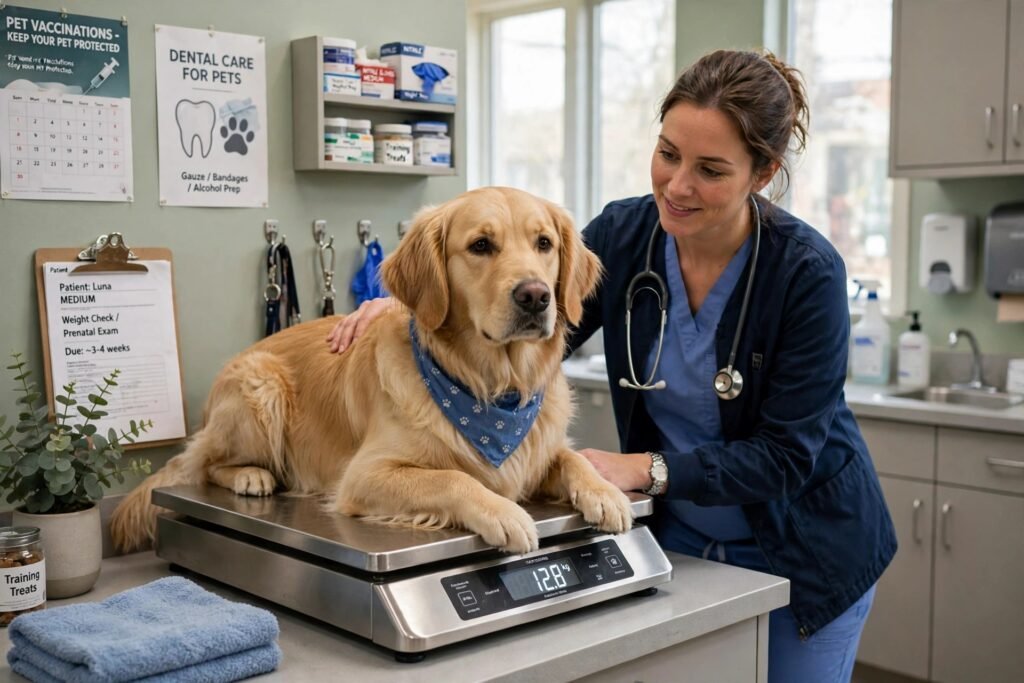
Weigh her weekly and keep her lean-but-covered: you should feel ribs with light pressure. Gaining excessive fat makes whelping harder.
Smaller, more frequent meals
By week 7, puppies take up serious abdominal space. Offer 3–4 smaller meals a day (or free-choice feeding of dry puppy food if she self-regulates well) so she can eat enough without discomfort. Always keep fresh water available — hydration matters enormously for milk production later.
Week-by-Week Feeding Summary
Use this as a simple planning map alongside your vet’s advice. Percentages refer to her normal pre-pregnancy daily food amount.
- Weeks 1–2: 100% of normal food. No change needed. Confirm the pregnancy plan and feeding approach at a vet visit.
- Weeks 3–4: Still 100%. Watch for a mild appetite dip around week 3 — tempt her with slightly warmed food, but do not panic or start adding rich extras.
- Week 5: Begin switching to puppy/growth food over 5–7 days (25% new, then 50%, then 75%, then 100%).
- Week 6: 100% puppy food, at about 110% of her old daily amount.
- Week 7: Increase to roughly 120–130%. Split into three meals.
- Week 8: Roughly 130–140%, in three to four smaller meals or free-choice dry food if she self-regulates.
- Week 9 (whelping week): Up to about 150% for large litters, less for small ones. Expect appetite to drop sharply in the final 12–24 hours before labour — this is normal.
- Nursing weeks 1–4: Continue puppy food. Intake climbs to roughly 2× normal in week 2 and up to 3× at peak (weeks 3–4) for a large litter. Free access to food and water is usual in this phase.
A Sample Day Late in Pregnancy (Week 8)
For a medium dog of about 15 kg (33 lb) whose normal ration was 250 g of adult food a day, eating a puppy food at roughly 400 kcal per 100 g:
- 8 am: 100 g puppy food, slightly warmed if she is fussy.
- 1 pm: 100 g puppy food.
- 6 pm: 100 g puppy food.
- 9 pm: a final small meal of 40–50 g before bed — an emptier overnight stomach can worsen morning nausea in late pregnancy.
Total: about 340–350 g, roughly 35–40% above her normal intake, adjusted by her weekly weigh-in and body condition. Smaller breeds scale down proportionally; giant breeds and large litters scale up. The numbers are illustrations — your food’s calorie density and your vet’s guidance set the real ones.
Dry, Wet, or a Mix During Pregnancy? Pros and Cons
Dry puppy food
Pros: the most calorie-dense per mouthful — valuable when stomach space shrinks; easy to leave out for free-choice feeding in late pregnancy and lactation; economical for large breeds; stores safely.
Cons: less aromatic, so a nauseous or fussy mother may prefer something smellier; she must drink plenty alongside it.
Wet puppy food
Pros: highly palatable and hydrating — an excellent tempt-the-appetite tool in the “morning sickness” phase and for the first meals after whelping; soft texture suits sore or tired mothers.
Cons: far fewer calories per gram, so she must eat a large volume; opened cans need refrigeration; long-term, wet-only feeding costs significantly more.
The practical compromise most breeders use: dry puppy food as the nutritional base, with a spoonful or two of wet puppy food stirred through at the fussier stages. Whatever you choose, the label must say it meets growth/reproduction (gestation/lactation) requirements — that wording matters far more than the format.
Supplements: Less Is More
Well-meaning owners often reach for supplements, but with a complete puppy food this can backfire:
- Do NOT add calcium supplements during pregnancy. Oversupplementing calcium before whelping can actually increase the risk of eclampsia (milk fever) after birth, a dangerous emergency. The calcium in a proper growth food is sufficient.
- Avoid kitchen-addition experiments like extra meat on top of a balanced food — large amounts unbalance the diet. A small amount of plain cooked egg or a little plain yogurt as a treat is harmless for most dogs, but keep extras under 10% of intake.
- Folic acid and other supplements are sometimes discussed for certain breeds — only use them if your vet advises it.
Feeding Around Whelping and Nursing
Many dogs refuse food 12–24 hours before labour — that is normal. After whelping, appetite returns quickly, and during weeks 2–4 of nursing her energy needs peak. Continue the puppy food free-choice or in 3–4 meals, with constant water. She will naturally eat less as puppies wean at 6–8 weeks; then transition her back to adult food gradually over a week. During nursing, keep food and water within her easy reach near the whelping box — new mothers often refuse to leave their puppies for long, and a hungry, thirsty mother produces less milk. If she will not eat away from the box, bring small meals to her.
Troubleshooting Common Pregnancy Feeding Problems
- “Morning sickness” around week 3. Hormonal changes can cause a few days of pickiness or a single vomit. Offer small, bland, slightly warmed meals and keep them frequent. If vomiting repeats, lasts beyond a couple of days, or she stops drinking, call your vet.
- Constipation in late pregnancy. The womb presses on the bowel. A little plain canned pumpkin (1 teaspoon per 5 kg / 11 lb of body weight, mixed into food) and gentle walks help most dogs. Never use human laxatives unless your vet prescribes them.
- Eating too little in the final week. Stomach space is limited, so think calorie density, not volume: puppy food, four small meals, and a bedtime snack. Weigh her — steady or slowly rising weight is reassuring; actual weight loss in late pregnancy needs a vet check.
- Eating too much, too fast. Some mothers gain excessively, especially with free-choice feeding. Weigh weekly; if she is gaining well beyond the 15–25% guide, switch to measured meals and discuss amounts with your vet. Fat mothers have harder whelpings.
- Single puppy or very large litter. Needs diverge: a single puppy means she may need far less extra food than the standard schedule, while a giant litter can push requirements dramatically higher. Litter size, known from your vet’s ultrasound or X-ray, fine-tunes the plan.
Your Whelping-Day Feeding Kit
Prepare these during week 8 so labour day is calm:
- Her usual puppy food, plus a small supply of a highly palatable wet puppy food for the first post-whelping meals.
- Fresh water and a bowl that fits safely in or beside the whelping area.
- A glucose source (such as honey) only if your vet has advised keeping one for the mother during a long labour — ask in advance.
- Your kitchen scale for weekly mother weigh-ins, and a small scale for daily puppy weigh-ins after birth (puppies should gain steadily; your vet will give you targets).
- Your vet’s phone number, including the out-of-hours service, written down where you will actually find it.
Foods and Items to Avoid During Pregnancy
- Raw meat diets (risk of Salmonella and Listeria to her and the litter)
- Cooked bones, which splinter
- Onions, garlic, grapes, raisins, chocolate, and xylitol — all toxic to dogs
- Herbal remedies or human supplements unless your vet has approved them

Frequently Asked Questions
When should I switch my pregnant dog to puppy food?
Begin the gradual switch around week 5, mixing increasing amounts over 5–7 days so she is fully on the growth food by about week 6.
How much weight should a pregnant dog gain?
A total gain of roughly 15–25% of her normal body weight by whelping is typical for an average litter, but this varies with breed and litter size — track it with your vet.
My pregnant dog has gone off her food. Is that normal?
Mild appetite dips around week 3 (a “morning sickness” phase) and in the final day before labour are common. Refusal lasting more than a day, vomiting, or lethargy needs a vet call.
Can I feed homemade food during pregnancy?
Homemade diets are difficult to balance for reproduction, where calcium and nutrient precision really matter. If you prefer home cooking, have a veterinary nutritionist formulate the recipe — do not improvise during pregnancy.
Do pregnant dogs need extra calcium for the puppies’ bones?
Not beyond what a growth-formula food provides. Adding calcium is a common and risky mistake; see the supplement section above.
What are the warning signs of eclampsia (milk fever) after whelping?
Restlessness, panting, whining, stiffness, muscle tremors, or wobbliness in a nursing mother — usually in the first few weeks after birth, most often in small breeds with large litters. This is a genuine emergency: contact a vet immediately, and do not wait to see if it passes.
Can I keep feeding her normal treats during pregnancy?
A few of her usual treats are fine, but keep all extras under about 10% of daily intake so the balanced puppy food does the real work. Avoid raw chews and anything with ingredients you cannot identify, and never give cooked bones.
When do I stop the puppy food after the puppies are weaned?
Once the puppies are fully weaned (usually by 7–8 weeks) and her milk is drying up, transition her back to adult food over about a week, reducing total amounts back to her normal ration as you go. Keep weighing her — she should return close to her pre-pregnancy condition over the following month or two.
Conclusion
The best food for a pregnant dog is a complete, high-quality puppy (growth) food, introduced gradually from about week 5, fed in increasing amounts and smaller frequent meals, with no added calcium or unbalanced extras. Pair that with weekly weigh-ins, gentle exercise, and your vet’s guidance at every stage, and you will nourish both mother and puppies through pregnancy, whelping, and nursing with confidence.