

It is one of the first questions every new puppy owner asks — and one of the easiest to get wrong. Feed too little and your puppy may not grow as they should; feed too much and you risk upset tummies now and weight problems later. The good news is that dry food feeding is mostly simple maths: how much your puppy needs depends on their current weight, their expected adult weight, and the calorie content of the food you use.
This guide gives you a practical chart to start from, then shows you how to fine-tune portions by watching your puppy’s body, which is what vets recommend.
Why Puppy Portions Are Different from Adult Portions
Puppies are building bones, muscles, organs and brains all at once, so per kilo of body weight they need roughly twice the energy of an adult dog, plus more protein, fat, calcium and phosphorus in the right balance. That is why you should always use a food labelled for puppies (or “growth”), and why the feeding guide on a puppy food bag is your best starting point — different kibbles contain different calories per cup.
One important caution: large and giant breed puppies (Labradors, Golden Retrievers, German Shepherds, Rottweilers and similar) should grow steadily, not fast. Overfeeding calories and calcium can contribute to joint problems, so for big puppies, lean and steady beats chunky every time.
Puppy Feeding Chart by Weight
The chart below is a general guide for a typical puppy kibble of around 380–400 kcal per cup (about 100 g). Always compare it with your own food’s bag guide, and adjust by body condition.
Current puppy weight — total dry food per day
- 1–2 kg (2–4 lb): ½–¾ cup (50–75 g)
- 2–3 kg (4–7 lb): ¾–1 cup (75–100 g)
- 3–5 kg (7–11 lb): 1–1⅓ cups (100–135 g)
- 5–7 kg (11–15 lb): 1⅓–1¾ cups (135–175 g)
- 7–10 kg (15–22 lb): 1¾–2¼ cups (175–225 g)
- 10–15 kg (22–33 lb): 2¼–3 cups (225–300 g)
- 15–20 kg (33–44 lb): 3–3¾ cups (300–375 g)
- 20–30 kg (44–66 lb): 3¾–4¾ cups (375–475 g)
- 30–40 kg (66–88 lb): 4¾–5¾ cups (475–575 g)
These are daily totals, to be divided into meals — not the amount per meal. Young puppies in their fastest growth phase (roughly 2–4 months) sit toward the top of their range; as growth slows after about 6 months, move toward the middle or lower end.
A Worked Example: Putting the Chart Into Practice
Charts make more sense with a real puppy. Imagine Bella, a 12-week-old Labrador puppy who weighs 8 kg. Looking at the chart, an 8 kg puppy falls in the 7–10 kg row: about 1¾–2¼ cups (175–225 g) of dry food per day. Bella is in her fastest growth phase, so her owner starts near the top of the range, at about 220 g per day.
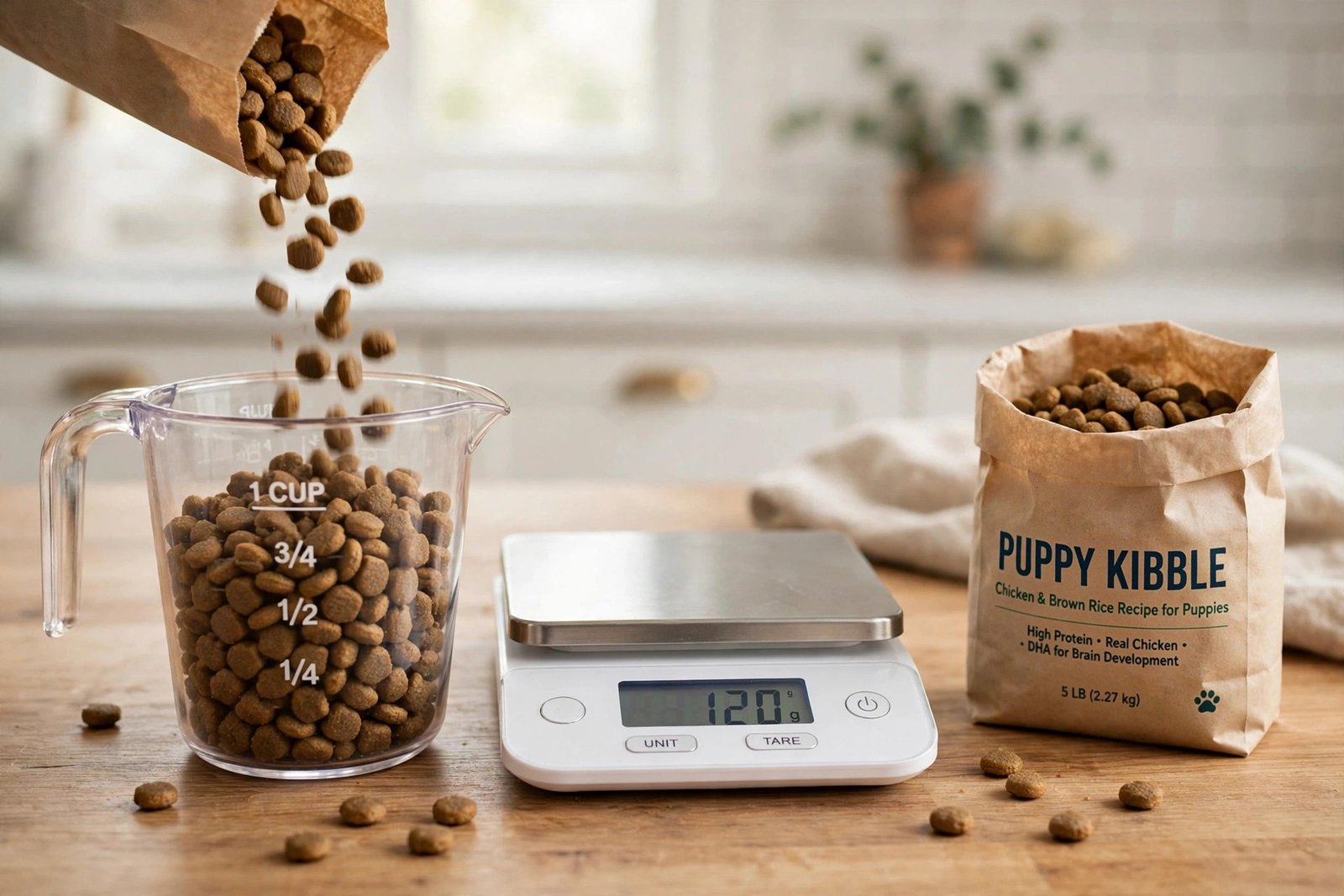
At 12 weeks, Bella eats 3 meals a day, so each meal is roughly 73 g — weighed on a kitchen scale, not guessed by eye. After a week, her owner does the hands-on body-condition check described below: ribs easy to feel, a slight waist visible, weight up steadily. The amount is right.
Six weeks later Bella weighs 12 kg. She now sits in the 10–15 kg row (225–300 g per day), but her growth rate has slowed a little, so her owner picks the middle of the range, about 260 g, split into 3 meals of roughly 87 g. Notice the pattern: the daily total keeps rising as Bella grows, but the amount per kilo of body weight gradually falls. That is normal, and it is why weighing your puppy — not just using the same scoop forever — is the habit that keeps portions right.
A Sample Feeding Day by Age
Regular times help digestion, toilet training and your puppy’s sense of security. Here is a typical pattern:
- 10-week-old puppy, 4 meals: 7:00 am first meal after the first toilet trip; 12:00 pm second meal; 5:00 pm third meal; 9:00 pm last meal, early enough for a final toilet break before bed.
- 4-month-old puppy, 3 meals: 7:00 am, 1:00 pm and 6:30 pm, with training treats in between taken from the daily ration.
- 8-month-old puppy, 2 meals: 7:30 am and 5:30 pm, timed so the evening meal is digested before bedtime exercise and the last toilet trip.
Adjust the clock to your household, but keep the gaps between meals reasonably even and avoid vigorous play for about 30–60 minutes after a meal — especially in large, deep-chested breeds, where owners are advised to be careful about exercise around mealtimes. Offer fresh water at all times; puppies drinking a lot more than usual, or far less, is worth mentioning to your vet.
How Many Meals Per Day?
Meal frequency matters as much as the total amount, because small stomachs hold small amounts:
- 8–12 weeks: 4 meals per day
- 3–6 months: 3 meals per day
- 6–12 months: 2 meals per day
- Over 12 months: 1–2 meals per day (most owners keep 2)
Large breeds often move to adult food later — around 12–18 months — while small breeds mature faster, at roughly 9–12 months. Your vet can confirm the right switch point for your puppy.
How to Weigh and Measure Accurately
A kitchen scale is the most reliable tool you can own. A “cup” of kibble can vary by 20% or more depending on how heaped it is and the size of the kibble pieces. Weighing takes ten seconds: put the bowl on the scale, zero it, and add the day’s grams or the meal’s share.
Check your food’s label for its energy density (kcal per 100 g or per cup). If your food is much richer than about 400 kcal per cup, feed a little less than the chart; if it is lighter, feed a little more — then let body condition make the final decision.
Reading Your Puppy’s Body Condition
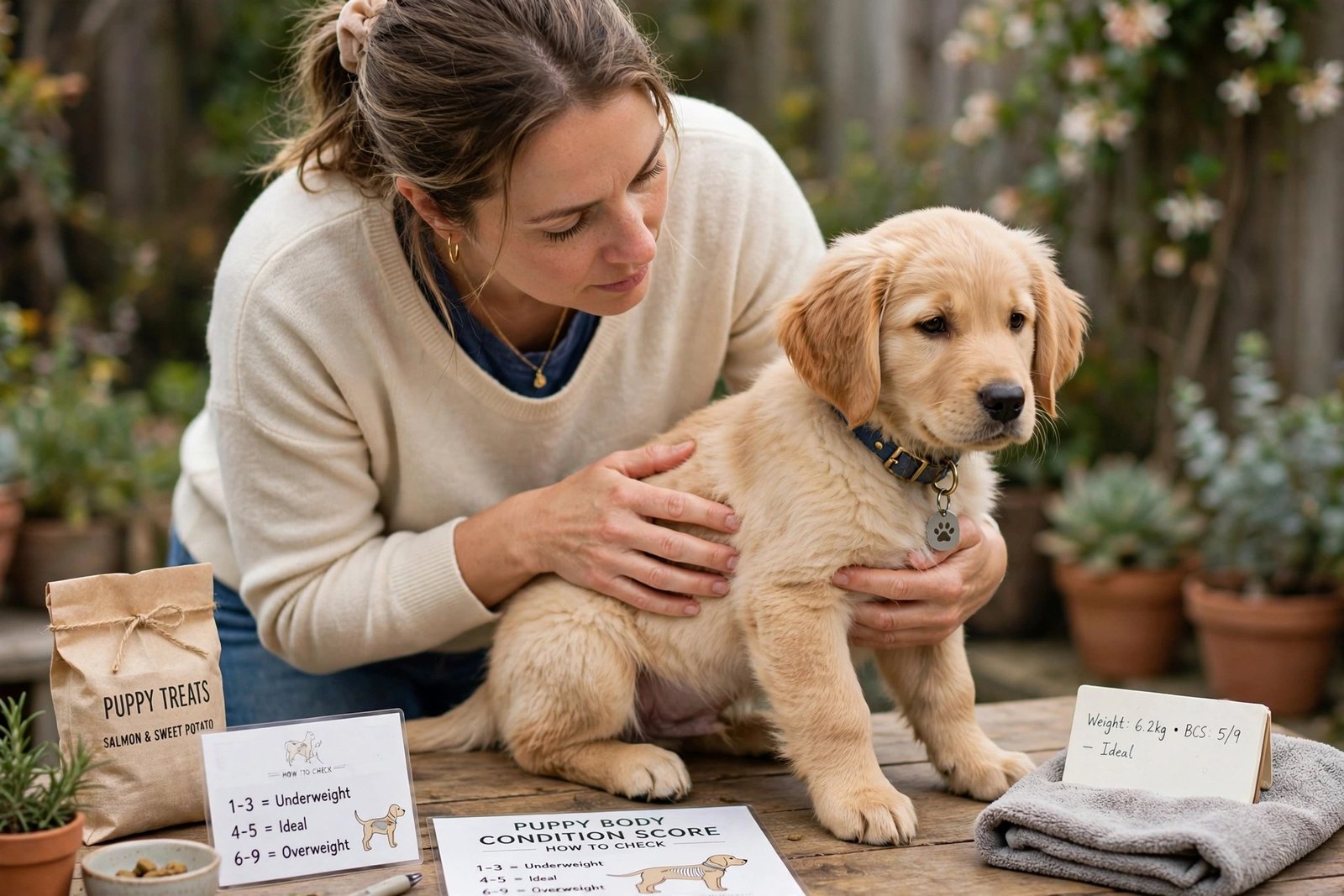
Weigh your puppy weekly during the first six months and note the number down. Then use your hands and eyes:
- Too thin: ribs, spine and hip bones are easily seen, and the tummy tucks up sharply.
- Just right: ribs are easy to feel under a thin layer of fat but not visible; from above, there is a gentle waist behind the ribs; from the side, the tummy tucks up slightly.
- Too heavy: ribs are hard to feel, the waist disappears, and the belly looks round.
Adjust portions by about 10% at a time and re-check after a week. Growth spurts are normal — a puppy may suddenly look lean for a week, then fill out.
Special Cases That Change the Numbers
Large and giant breeds. Labradors, Shepherds, Rottweilers and Great Danes should be fed for slow, steady growth. Many vets aim these puppies at the middle or lower half of their chart range, using a large-breed puppy food with controlled calcium, and weigh them every two weeks. A lean big puppy is a healthy big puppy.
Tiny and toy breeds. Small puppies have small stomachs, fast metabolisms and a real risk of low blood sugar if they go too long without eating. Very young toy-breed puppies may need their daily amount spread over 4–5 small meals, and any missed meals in a tiny puppy under 12 weeks deserve a same-day call to the vet.
Very active puppies and working breeds. Border Collies, spaniels and other high-energy puppies may need the top of their range or slightly above during growth spurts. Body condition is the referee: if ribs feel too prominent and weight gain stalls, add about 10% and reassess in a week.
Neutering. After neutering, energy needs usually drop a little. Many vets suggest trimming portions by roughly 10% around the operation and monitoring weight closely for the following two months, when unwanted gain often creeps in.
Picky puppies and slow starters. Warm the kibble slightly or add a splash of warm water to release aroma, feed in a quiet place, and pick the bowl up after 20 minutes rather than leaving food down and topping it up all day. A puppy who is bright and growing is rarely starving himself — but a puppy who refuses food and seems unwell needs a vet, not a new recipe.
Common Feeding Mistakes to Avoid
- Using the scoop that came with the bag without ever weighing. Scoops encourage overfilling; a kitchen scale removes the guesswork.
- Feeding by the puppy’s enthusiasm. Many puppies would eat double their needs if allowed. Appetite is not a measuring tool.
- Following a chart for the wrong food. Charts assume a typical calorie density. If your kibble is much richer, the same cups deliver far more energy.
- Topping up “just a bit” at every meal. A little extra four times a day quietly becomes 25% too much food.
- Stopping weigh-ins after the first month. The fastest changes happen between 3 and 8 months — exactly when regular checks matter most.
- Switching foods suddenly because portions “look wrong.” Any food change should be gradual over 7 days to avoid diarrhoea, and portion questions should be settled by body condition, not by how full the bowl looks.
Treats and Extras Count Too
Training treats add up fast with a puppy learning all day. Keep treats to roughly 10% of daily calories, use tiny pieces (or part of the puppy’s weighed kibble ration as rewards), and subtract a little from meals if you have had a heavy training day. Avoid giving lots of rich “extras” like cheese and sausage, which unbalance a carefully designed puppy diet.
Frequently Asked Questions
My puppy still seems hungry after meals. Should I feed more?
Many puppies — Labradors especially — always act hungry. First check body condition and growth: if your puppy is gaining steadily and you can feel ribs easily, they are probably fine. Try a slow-feeder bowl to make meals last longer, and confirm the amount with your vet at the next check.
Can I leave dry food down all day for my puppy?
Free-feeding makes portion control impossible and can delay toilet training, because meals drive a predictable toilet routine. Measured meals at set times are better for almost every puppy.
Should I soak the kibble for a young puppy?
For puppies under about 10–12 weeks, soaking kibble in warm water for 10–15 minutes makes it softer and easier to eat. After that, dry kibble is fine and helps keep teeth busy.
What if my puppy skips a meal?
One skipped meal in an otherwise bright, playful puppy is usually nothing to worry about — teething and excitement are common causes. If your puppy misses two meals, seems unwell, or is very young or a tiny breed, contact your vet the same day, as small puppies can become unwell quickly.
When do I reduce portions as my puppy grows?
Puppies need relatively less food per kilo as growth slows. Weigh weekly, follow body condition, and expect the per-kilo amount to drop noticeably after about 6 months, even though the total daily amount may still rise with body weight for a while.
How do I change from the breeder’s food to a new food?
Keep your puppy on the food they arrived with for the first week or so, while they settle in. Then mix gradually over 7 days: 25% new food for two days, 50% for two days, 75% for two days, and 100% new food from day seven. If stools soften, stay at the current step for an extra day or two before moving on.
My puppy gulps food down in seconds. What can I do?
Try a slow-feeder bowl with ridges, a lick mat pressed with a little soaked kibble, or scatter the meal in short grass so your puppy has to hunt for it. Splitting the ration into smaller, more frequent meals also helps. Gulping is common, but if your puppy regularly coughs, gags or vomits after eating, mention it to your vet.
Should I add wet food or toppers to the dry food?
You can, in small amounts — a spoonful of the same brand’s puppy wet food adds variety and aroma. Keep toppers to about 10% of daily intake, and if you add wet food regularly, remove an equivalent amount of dry food (wet food is mostly water, so the swap is not gram-for-gram — check both labels’ calories). A diet that is mostly dry, complete puppy food is the simplest way to keep nutrition balanced.
Conclusion
Start with the feeding chart and your food’s own label guide, split the daily total into age-appropriate meals, weigh portions with a scale, and then let your puppy’s ribs and waist fine-tune the amount. Pair that routine with regular vet weigh-ins, and you will raise a puppy that grows steadily, feels full and satisfied, and arrives at adulthood at a healthy weight.